 Preferred Store:
 My Account Sign-In






Sign-up for {N}power to get exclusive discounts, newsletters, members-only features, and more!
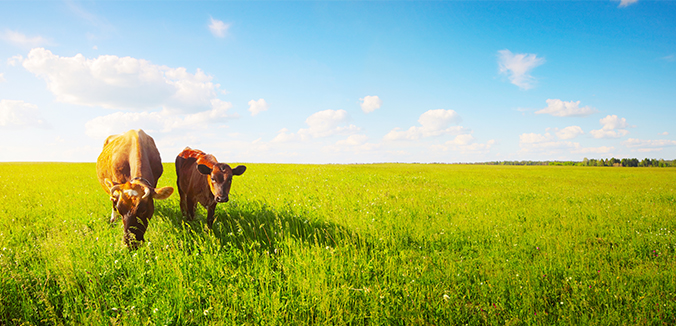
At Natural Grocers, we strongly believe that our food choices have the potential to affect real change. It's one of the reasons we're in this business. We know that the way food is raised matters and this is no truer than with beef. As a critically acclaimed writer and author of Water in Plain Sight, Judith Schwartz, writes: "The ecological impact...of eating beef has become a fraught topic...What often gets lost, however, is that the impact varies greatly depending on how cattle are reared."
In this month's feature article, Schwartz describes the important role that pastured cattle play in the earth's natural water cycle, and ultimately, the health of the earth. Your purchasing power really does have the potential to change the world.
Rancho las Damas, a few hours southeast of El Paso into the Chihuahuan Desert rangelands, is an oasis of high grasses, birds, and butterflies–and some very robust cattle. Many surrounding ranches are struggling, the dusty land dotted with brushy mesquite and the occasional “vaca flaca” (skinny cow). The neighboring ranchers say to Alejandro Carrillo, a former IT professional now managing the family property, “Of course you have more water. You get more rain at your ranch!”
I visited the Chihuahuan Desert grasslands in 2014 and can understand why someone would have that impression. For driving this vast landscape with Carrillo was like embarking on a tour of water cycle dysfunction. We stopped by erosion gullies so deep you could get vertigo. We passed hovels where desperate farmers spend more money than they have to buy feed for their cattle. We stretched our legs near the remains of a water well, a spot once so fertile it was nick-named “Eden,” the land now parched and the few plants twiggy and exposed at the roots. By contrast, Rancho las Damas, named for the Sierras las Damas mountains that loom nearby, is bursting with life. It’s unlikely the ranch receives more precipitation than properties a quarter-mile away. Rather, the difference is in how Carrillo and his team steward the land. Specifically, how they manage their cattle.
The ecological impact of raising cattle—and by extension, of eating beef—has become a fraught topic. One frequent concern is that meat production uses a lot of water and creates water pollution. What often gets lost, however, is that the impact varies greatly depending on how cattle are reared. As nutritionist and author Diana Rodgers puts it, “It’s Not the COW, It’s the HOW.” (Or as I’ve said in talks, “It’s awfully cheap for us to blame animals for our failure to manage them properly.”) There’s a metric called the “Water Footprint” intended to reveal how much water is required to produce different foods, and beef is deemed particularly thirsty. It’s important to understand that these figures refer to industrial livestock that are fed irrigated crops. Cattle on the land, like the 600 or so at Rancho las Damas, eat the forage that grows there.
As for water quality, consider the feedlot: cattle are confined and their waste runs into lagoons. This fouls area water—particularly when heavy rains lead to overflow— and creates the ideal conditions for the production of methane. (All ruminants emit methane as part of their digestive process. However, healthy grassland soil contains methanatrophic—methane-eating—bacteria, so methane is kept in balance.) When cattle are on pasture, their waste is broken down by microorganisms and enriches the soil. This, plus the organic matter added when cattle moved as a herd trample down plant material, bolsters carbon in the soil, which acts as a sponge. According to the USDA, every one-percent increase in soil organic carbon represents an astounding 20,000 gallons of water per acre that can be held on the land.
In other words, it’s not that cattle reared on grass is “using” the water so much as that they are playing a role in the local water cycle. When cattle are managed in a way that builds healthy soil, they are adding water to the system—water that would otherwise be lost to evaporation or sluice away in gullies or slide across the lifeless dirt. And in the process dragging along topsoil that ends up as sediment in our waterways. Carrillo’s neighbor didn’t understand why, but he saw that Rancho las Damas had the benefit of more water.
To understand the paradox of why cattle can lead to more water on the land, we can go back in time—way back, as in millions of years ago, during the expansion of grasslands. (Think: prairie, steppe, pampas, savanna, a category of the landscape that represents about a third of the world’s land mass.) Scientists believe that grasslands and grazing animals co-evolved so that the land needs the animals in the same way that the animals need the land. Herbivores nibble on the grass in a way that promotes plant growth. However, the specter of predators keeps them moving so that grasses are not eaten down to the ground. The grazers evade pack-hunting predators by bunching up and fleeing en masse, pressing down seeds and plant residue in the process. This predator-prey relationship is essential to grassland choreography.
The person most responsible for bringing these insights to contemporary cattle-raising is Allan Savory, who developed Holistic Management. Savory, now 82, grew up in Zimbabwe (then Rhodesia) and was saddened by the decline of wildlife he saw even as a young man. The accepted explanation was that there were too many animals. While working for the national game park, he observed that when land was subsequently “protected” by keeping animals away, the conditions worsened. Clearly, there was more to the story than curtailing animal numbers. After years of studying how animals behave and influence the land, he understood that livestock could serve as a proxy for wild herbivores if managed to mimic their natural rhythms. He developed a decision-making framework that can be applied to land management—a land-healing approach that’s being applied to tens of millions of acres across the world.
Savory observed that the grazing dynamic is especially important where there are distinct dry and rainy periods, what he calls “brittle” landscapes. Such ecosystems need some mechanism to maintain moisture in the soil from the end of one rainy season and the beginning of the next. What solution did Nature come up with? The behavior and digestive system of ruminant animals. This is an important concept for people in places hurting for water, particularly where drought alternates with flooding—a pattern that has become painfully familiar in recent years.
Not long after my visit to Chihuahua I went to the African Centre for Holistic Management in Zimbabwe and saw how restorative grazing had transformed the landscape. The Dimbangombe River now flows a full kilometer farther than it had in living memory. Reeds and sedges— plants that flourish on moist land—line the newly stabilized banks. I visited two villages working with the Africa Centre where bringing animals onto crop fields enabled people to get o¨ international food aid. The increase in soil organic carbon meant enhanced water infiltration, which, in turn, meant that people could grow crops seven months of the year instead of between two and three months. And that made the difference between self-sufficiency and dependence on aid.
Holistic Management can play a role in enhancing water cycling in any landscape. Matt Maier is the owner and “Chief Grass Farmer” of Thousand Hills Lifetime Grazed, Natural Grocer’s main supplier of grass-fed beef. His third-generation family farm is based in “a very hilly area” of Minnesota, and water is very much on his mind. “We’ve watched this terrain get plowed and tilled and planted with corn and soybeans for decades,” says Maier, who has returned to the land his father bought in 1959. “Most of the topsoil and whatever it’s been treated with has been washed into wetlands, streams, and ponds, whatever is at the bottom of the hill.” To avoid this scenario the land needs to be covered with forage all year. “We’re putting organic matter back into the soil. This captures water like a sponge and holds that water for the plants and the plants keep the soil in place. Let the cattle do all the work—you just have to manage them properly. Regenerating soil is the mission. The byproduct is nutrient-dense food. If we don’t have vibrant soil, we don’t have a food system in this country.”
Alejandro Carrillo says that holistic planned grazing is expanding in Chihuahua, in part through the education and networking provided through Pasticultores del Desierto, a nonprofit and colleagues have founded. He has heartened that many young people attend the workshops: “These are people in their late 20s. If they already know what they know now, they will be so much better than us!” A neighbor whose ranch spans 100,000 acres is now taking up holistic planned grazing. “He said to me, ‘I want to have my ranch like yours. Whatever it takes.’ I did not convince him. He convinced himself,” Carrillo told me. “Think of the birds that can come to that land. Imagine the bare ground that it’s been, and the temperature it raises. Better management will create a better microclimate.”
Carrillo said that he and area colleagues have changed management so that they are moving cattle more frequently onto smaller paddocks. It’s making a difference, he said: “The period of green-up is extending. We finally are seeing green in all the perennial grasses all year round. The moisture is important. During the summer, we have more of those days when we have mist. That didn’t happen in the past because we didn’t have the grass.” Moisture from mist and dew may seem insignificant, but it supports plants and microbial life. Carrillo says also that the earth ponds he dug are now holding water through the year. “I think the water is going underground and feeding the pond.”
For family-run livestock producers like Rancho las Damas and the 30 or so farms that sell through Thousand Hills Cattle Co., managing animals on land is about more than creating a project. Matt Maier is proud that there are now four generations on the farm—and that there’s an ongoing commitment. “My 17-year-old son said to me, ‘I hope you never sell this land.’ I said we could make a deal: ‘I’ll never sell this land if you won’t sell this land.”
Sign-up for {N}power to get exclusive discounts, newsletters, members-only features, and more!